Cleaning Solar Panels: Does It Actually Improve Output? (With Simple Green Guide)
Here's the question nobody asks directly: do dirty solar panels actually lose meaningful output?
And the honest answer is: it depends on where you live. In some climates, rainfall does almost all the cleaning for you. In others — dusty regions, high pollen seasons, near-coastal areas with salt spray — dirty panels can lose 15–25% of their output.
In this guide I'll show you exactly when cleaning makes financial sense, the simplest safe method using Simple Green, how to clean solar panels without getting on the roof, and what cleaners to avoid.
In this guide, you'll learn:
- Does Cleaning Solar Panels Actually Improve Output?
- How Often Should You Clean Solar Panels?
- Cleaning Solar Panels with Simple Green: Step-by-Step
- How to Clean Solar Panels Without Getting on the Roof
- Best Time of Day to Clean Solar Panels
- Cleaning Ash and Pollen off Solar Panels
- What Cleaners and Methods to Avoid
- Safe Cleaners for Solar Panels: Comparison
- FAQ
Does Cleaning Solar Panels Actually Improve Output?
The research is consistent: light soiling from normal weather reduces output by 1–5% in most temperate climates where rainfall is regular. That's often not worth the effort of cleaning.
But in specific conditions, the loss is much more significant:
- Desert climates with low rainfall: 15–25% output loss from dust is well-documented. Cleaning can recover almost all of this.
- High pollen seasons (spring): Pollen is sticky and doesn't wash off easily with rain. A single heavy pollen deposit can reduce output by 5–10%.
- Near-coastal areas: Salt spray forms a film that rain doesn't fully dissolve. Gradual buildup causes 5–15% loss.
- After nearby wildfires or construction: Ash and fine dust can coat panels and cause 10–25% loss within days.
- Flat-mounted panels: Panels tilted at less than 10° don't self-clean with rain. Dirt accumulates faster and cleaning is more beneficial.
The simplest way to know if cleaning is worth it: check your inverter output on a clear day before and after a clean. If output jumps by more than 5%, the cleaning is paying off. If it barely moves, rainfall is doing enough work on its own. No panels yet? A plug-in solar panel is the lowest-friction way to get started — no roof access or installer needed..
How Often Should You Clean Solar Panels?
For most UK and northern European homeowners with panels at a reasonable tilt (15°+): once or twice per year is sufficient — once in late spring after pollen season, once in autumn before the low-sun winter months.
For US homeowners in dusty states (California, Texas, Nevada, Arizona): 3–4 times per year, or after any significant dust event, wildfire, or pollen season.
A practical trigger: if you can see visible dirt on the panel surface from the ground, or if your inverter output has dropped on equivalent sunny days, it's time to clean.
Cleaning Solar Panels with Simple Green: Step-by-Step
Simple Green All-Purpose Cleaner is one of the safest and most effective options for solar panels. It's biodegradable, non-abrasive, pH-neutral when diluted, and won't harm the anti-reflective coating on panel glass or run-off onto plants.
The ground-level method (no ladder required) uses a garden hose sprayer with a soap bottle attachment — available online for under $20.
What you need
- Simple Green All-Purpose Cleaner (concentrated)
- Garden hose with a foam cannon / soap sprayer attachment
- That's it for ground-level cleaning
Step-by-step process
- Rinse first: Set the sprayer to plain rinse mode. Starting from the top of the array, work downward, thoroughly wetting all panel surfaces. This loosens and floats away surface dust before applying soap.
- Apply Simple Green: Switch the sprayer to soap mode. Work from top to bottom again, coating all panels evenly with the diluted Simple Green solution. Don't let it dry on the panels — move steadily.
- Dwell for 15–30 seconds: Let the solution work. Don't let it dry out — if it starts drying on the glass it will leave water spots.
- Rinse thoroughly: Switch back to rinse mode and work from top to bottom, rinsing all soap residue completely off the panels. Check that run-off water is running clear.
Simple Green does not hurt solar panels when used as directed. The concern about cleaners and solar panels is primarily about abrasive compounds, high-pH alkaline cleaners, and anything containing bleach — none of which apply to properly diluted Simple Green.
How to Clean Solar Panels Without Getting on the Roof
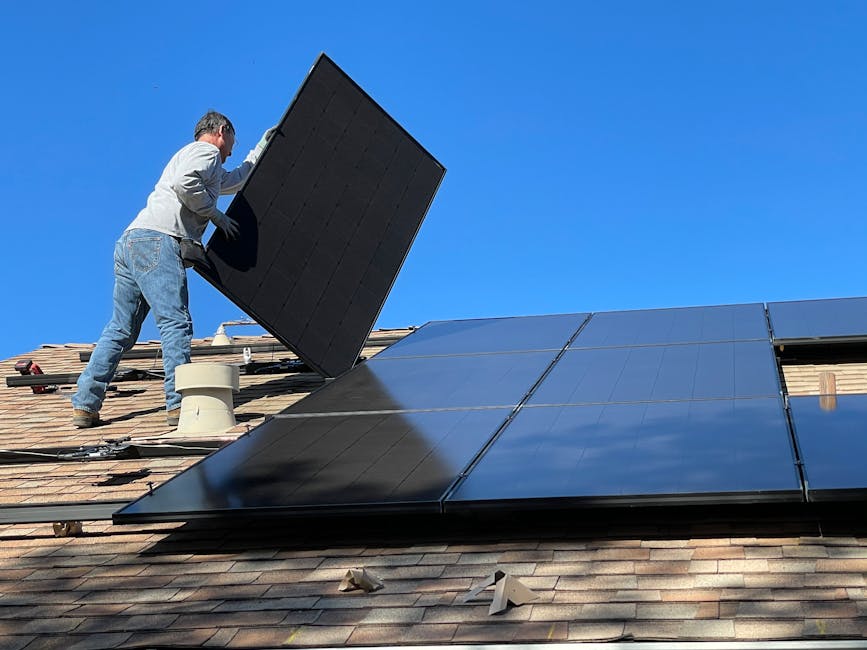
Getting on the roof is the single biggest deterrent to regular solar panel cleaning — and it's completely unnecessary for most residential installs.
The garden hose sprayer method above handles 90% of cleaning jobs from the ground. For panels that need more targeted attention:
- Telescoping soft-bristle brush: An 8–12 metre extendable window cleaning pole with a soft microfibre or boar-hair brush attachment lets you physically scrub panels from the ground. Use with just water — no soap needed for regular light cleaning with a brush.
- Deionised water fed pole: Used by professional window cleaners, these systems pump deionised water through the pole and brush head for streak-free results. Expensive to buy ($200–$500) but available to hire from tool rental shops.
- When you do need to go up: Use a proper scaffolding tower or hire a professional. Roof safety is not worth compromising. A professional solar panel cleaning service typically costs $100–$200 for a residential array and is worth the cost annually in dusty climates.
Best Time of Day to Clean Solar Panels
Clean in the early morning, late afternoon, or on a cloudy day. Avoid cleaning panels in direct afternoon sun for two reasons:
- Hot glass causes cleaning solution to evaporate quickly, leaving water spots and soap residue before you can rinse
- There's a small thermal shock risk (cold water on very hot glass) — unlikely to cause problems but not ideal
Early morning is ideal: panels are cool, often still slightly damp from dew, and the gentle cleaning won't heat back up any remaining moisture on the surface.
Cleaning Ash and Pollen off Solar Panels
Both ash (from wildfires, bonfires, or industrial sources) and pollen are more adherent than ordinary dust and benefit from the soap-rinse approach rather than plain water.
Ash: Rinse first with plenty of water to float ash particles off the surface. Then apply Simple Green solution and let it dwell 20–30 seconds before rinsing completely. Ash is alkaline and can leave a haze if not fully removed — a second rinse pass is worthwhile.
Pollen: Pollen is waxy and sticky. Plain water rinse often just spreads it. Soap is essential. The Simple Green method works well. For very heavy pollen buildup, apply soap, wait 1–2 minutes, then rinse thoroughly.
What Cleaners and Methods to Avoid
- Abrasive scrubbers, steel wool, rough brushes: These scratch the anti-reflective glass coating, permanently reducing output. Use only soft microfibre, soft-bristle brushes, or foam pads.
- High-pressure washers: The high-pressure jet can force water under panel frames, damage junction boxes, and strip sealant around cells. Standard garden hose pressure is safe; jet washers are not.
- Bleach or chlorine: These can degrade rubber seals and gaskets on panel frames and junction boxes over time.
- Strong alkaline or acid cleaners: Can damage the anti-reflective coating on the glass surface.
- Detergents with wax: Leave a residue film that reduces light transmission — the opposite of what you want.
- Tap water (hard water areas): Can leave calcium deposits as it dries. In hard water areas, use deionised water for the final rinse to prevent water spots.
Safe Cleaners for Solar Panels: Comparison
| Cleaner | Safe? | Effectiveness | Cost | Notes |
|---|---|---|---|---|
| Simple Green (diluted) | ✅ Yes | Excellent | Low | Biodegradable, safe for plants in run-off |
| Diluted dish soap (mild) | ✅ Yes | Good | Very low | Use sparingly — can leave film if not rinsed well |
| Plain water | ✅ Yes | Good for light dust | Free | Use deionised in hard water areas |
| Commercial solar panel cleaner | ✅ Yes | Excellent | Medium–high | Optimised for panel glass — no real advantage over Simple Green |
| Bleach / chlorine | ❌ No | — | — | Degrades seals and gaskets |
| Pressure washer | ❌ No | — | — | Risks water ingress and frame damage |
| Abrasive scrubbers | ❌ No | — | — | Scratches anti-reflective coating permanently |
Getting the most from your panels. Clean panels perform better — but so does a well-maintained system overall. The complete solar panel maintenance checklist covers everything beyond cleaning: inverter checks, wiring inspection, and annual performance verification. And the does rain clean solar panels guide answers whether manual cleaning is even necessary in your climate.
Frequently Asked Questions
Does cleaning solar panels improve output?
Yes, in the right conditions. In temperate climates with regular rainfall, cleaning may recover only 1–3% output. In dusty climates, after wildfire events, or during heavy pollen seasons, cleaning can recover 10–25% of lost output. Check your inverter data before and after cleaning to measure the actual benefit in your situation.
Is Simple Green safe for solar panels?
Yes. Simple Green All-Purpose Cleaner when properly diluted is pH-neutral, non-abrasive, and biodegradable. It does not damage panel glass, anti-reflective coatings, or frame seals, and it is safe for plant run-off. It is one of the best cleaners for solar panels available at this price point.
How often should you clean solar panels?
In temperate climates with regular rain: 1–2 times per year. In dry, dusty, or coastal climates: 3–4 times per year or after significant dust events. The best indicator is a measurable drop in output on equivalent sunny days compared to a clean baseline.
Can you clean solar panels from the ground?
Yes — a garden hose with a foam cannon or soap sprayer attachment handles most cleaning jobs from ground level without any ladder or roof access. For panels needing physical scrubbing, a telescoping soft-bristle brush on an extension pole reaches most residential rooftop arrays safely from the ground.
What should you not use to clean solar panels?
Avoid abrasive scrubbers (scratch the glass coating), high-pressure washers (risk water ingress), bleach or chlorine (degrades seals), strong alkaline or acid cleaners (damage anti-reflective coating), and hard tap water for the final rinse in areas with hard water (leaves calcium spots). Use soft brushes, mild biodegradable soap, and deionised water where possible.