How to Store Excess Solar Energy at Home [without Batteries!]
If you wondering how to store excess solar energy at home, today I am going to show you a very effective solution (how to store solar energy diy) without using expensive solar panels and batteries.
In fact, this exact solar storage technique helped me increase the indoor air temperature of my home and minimize substantial temperature swings in hallways, living rooms, and even in the greenhouse.
Well, is it true?
It sure is because I'm not talking about any conventional or commercially available residential solar system.
This complete system is entirely passive.
The best part?
There are no moving parts, cables, sensors, charge controllers, or electronics whatsoever. In other words, there's nothing that can get broken or that needs maintenance and fixing.
In fact, you'll need nothing more than a few large water-filled tanks to build the water thermal accumulator.
Let's do this!
Check this also: How to make a sand battery DIY?
But first, here are the topics you'll learn about in this post:
Using Water to Store Solar Energy at Home
There are numerous examples of water storage tanks being built into home interiors to form a thermal solar energy storage battery.
I have also stumbled upon a few interesting examples on DIY solar forums.
The primary role of such solar energy storage battery is to act as a buffer to the daily-nightly swings in temperature.
If you combine that with bubble wrap insulation on windows, you've got yourself a perfect combination for cutting down utility bills.
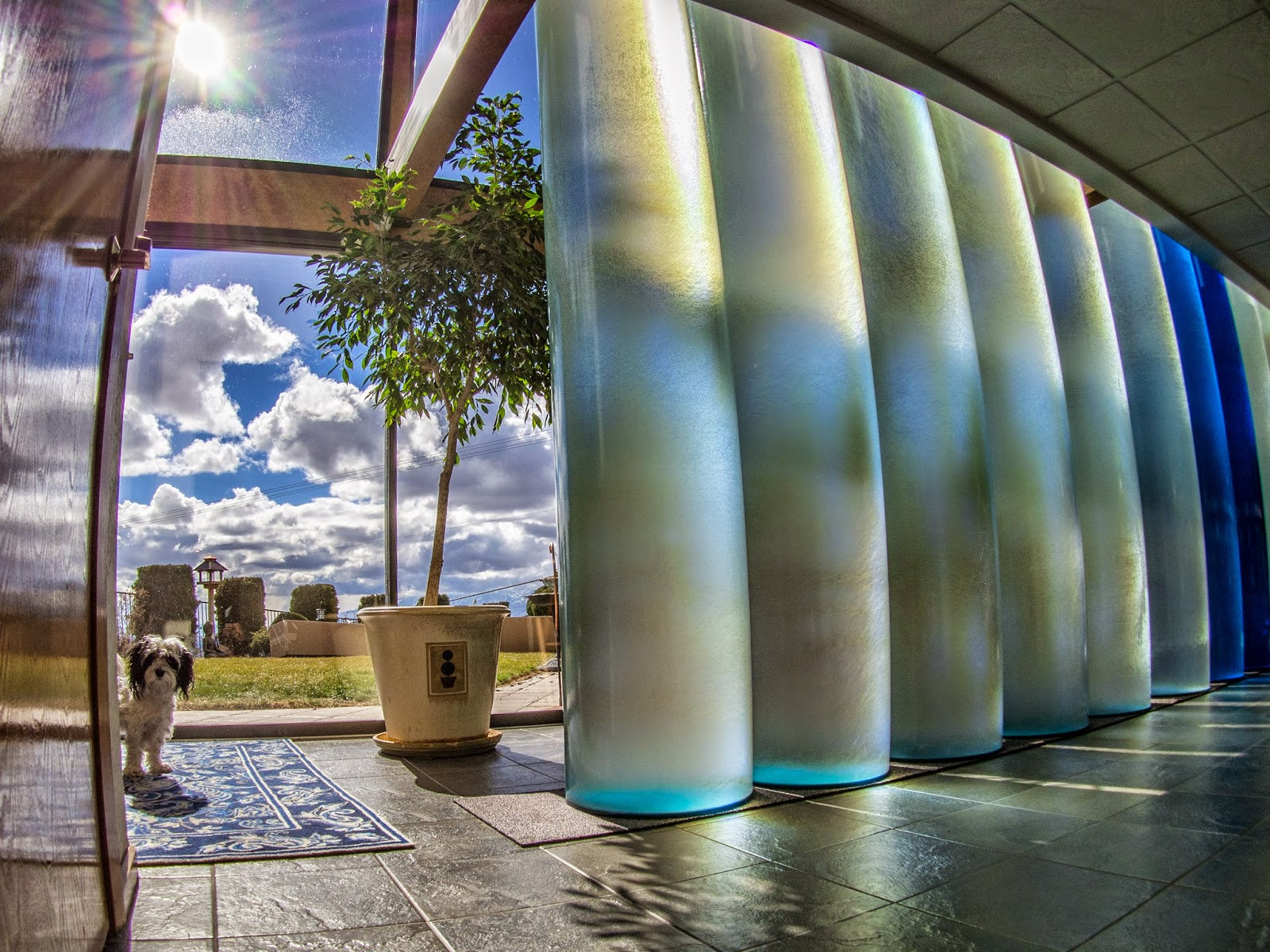
Solar water storage tanks placed near the south side window can provide not only a cool sculptural centerpiece for your home but can also drastically lower your heating bills and save you both electrical energy and money.
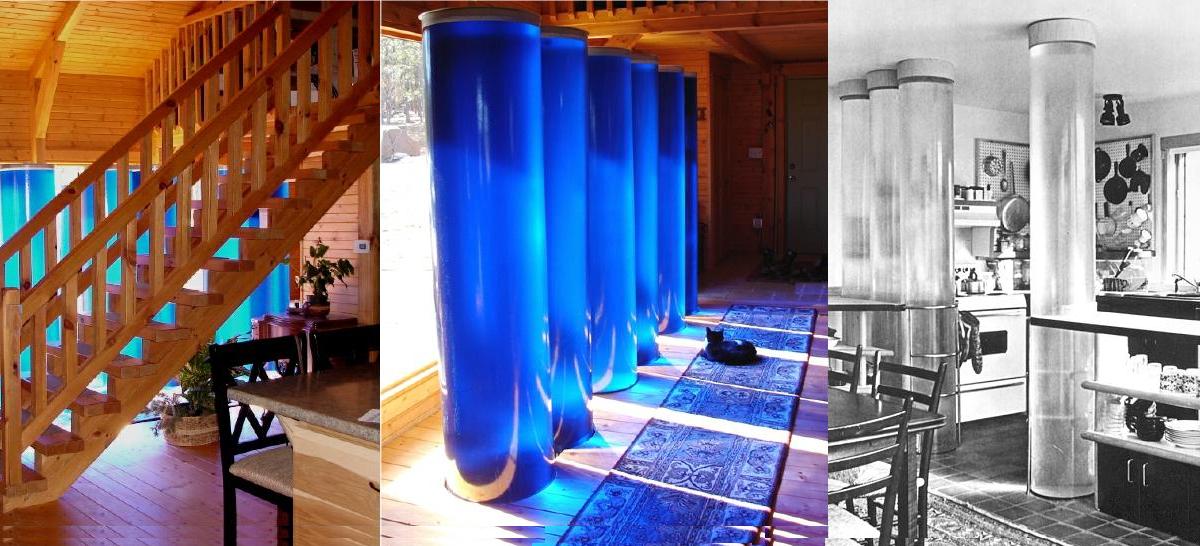
Besides their main role, solar tubes often serve as attractive accents or room space dividers. As you can see in the picture, adding dyes does not only provide the desired color effect but also increases solar gain (efficiency).
The most exciting thing about this innovative tube is that you can implement passive solar heating & cooling without any solar charge controllers, wires, or solar panels.
You only need to take several transparent fiberglass tubes, fill them with water, place them next to the south window (or wherever they can get maximum exposure to sunlight) so that tubes can absorb and store energy from the sun to fill your room with heat.
And that's it - once established, the system will work on its own.
Solar powers everything for free!
Passive Solar Energy Storage - How does it work?
Well, it's very similar to the Trombe walls. Water tubes form a "thermal mass" machine with no moving parts and a completely maintenance-free solar energy storage system.
Here's how it works:
The sun is a powerful energy source, yet humankind allows this free heat to go to waste. This system stores solar energy (in the form of heat) during the day and keep warm at night.
Thermal mass provides us with an inexpensive, non-mechanical way of storing the sun's heat.
Radiant heating and cooling are the most comfortable for us.
Water storage tubes represent a low-tech form of radiant system which prevents wide temperature swings by absorbing and diffusing solar energy.
The radiant energy of solar water storage will naturally regulate home temperature, but it can not substitute all our heating and cooling needs.
When installed to face the south window, solar tubes function as a Direct Gain Water Wall. Water absorbs and stores solar energy while allowing natural daylight to pass through.
Solar tubes temper both the light and heat from the sun by removing wide temperature fluctuations while also helping to reduce glare from the south-facing windows.
What is Water Storage Tank and Thermal Mass?
By definition, thermal mass is equivalent to thermal capacitance (heat capacity); in other words, it is the ability of a body to store thermal energy. If you check the Specific Thermal Capacity value for various materials, you will notice that water has a remarkably high thermal mass. It means that water can store more heat for a given volume comparing to other materials.
For example, water has more than double volumetric heat capacity compared to concrete or bricks. Water naturally absorbs and releases its heat to the surrounding air.
Another significant factor is that convection currents in water allow heat to travel around more quickly than in a solid object (like concrete or brick). Because of that, water can add or remove heat from our home without the external electrical energy supply.
You can quickly build your DIY solar battery and place it in your living room. Water storage tanks (also called "heat storage tubes") can range from 4 to 10 feet (1-3 m) in height with 12 to 18 inches (30-45 cm) diameter.
That kind of tube holds a lot of water, which corresponds to a lot of free heat for your home. If you plan to build the solar-tubes yourself, have in mind that the structure needs to hold and sustain a massive amount of water. Lot of weight and pressure comes along with such volumes.
It is also possible to install thermal energy accumulation tubes into a greenhouse. Imagine how much energy and money you could save by utilizing this simple solution.
So give it a go, and let me know what's your experience.
Frequently Asked Questions
How do water tanks store solar energy?
Water has an exceptionally high specific heat capacity — it absorbs more heat per kilogram than almost any other common material. Dark-coloured or transparent water tanks placed in direct sunlight absorb solar radiation during the day, heating the water. That stored heat is then released slowly as the surrounding air cools overnight, acting as a passive radiator that maintains room temperature without any electricity, controls, or moving parts.
How many water tanks do I need to heat a room?
As a rule of thumb, aim for 1–2 gallons of water storage per square foot of floor area as a starting point for passive solar thermal mass. A 200 sq ft room would benefit from 200–400 gallons (4–8 55-gallon drums). Position them in the sunniest south-facing location to maximise daily solar charging. Effectiveness depends heavily on how well-insulated the space is and how cold your winters get.
What colour should solar water storage tanks be?
Dark colours — black, dark blue, dark green — absorb the most solar radiation. A matte black surface can absorb over 95% of incident sunlight. If you want a visual feature in your living space, transparent fiberglass tubes filled with dark-dyed water combine aesthetics with excellent solar absorption. Avoid white or reflective tank surfaces as these reflect most of the solar energy you're trying to capture.
Can I combine water tank solar storage with other insulation methods?
Yes — and this is the most effective approach. Water thermal mass combined with bubble wrap window insulation → is a particularly powerful combination: the bubble wrap slows heat loss through the glass while the water tanks store the heat that would otherwise escape. Adding draught sealing to close all gap infiltration completes the system. Together, these three free or near-free measures can dramatically reduce heating bills in homes with single-pane windows.